
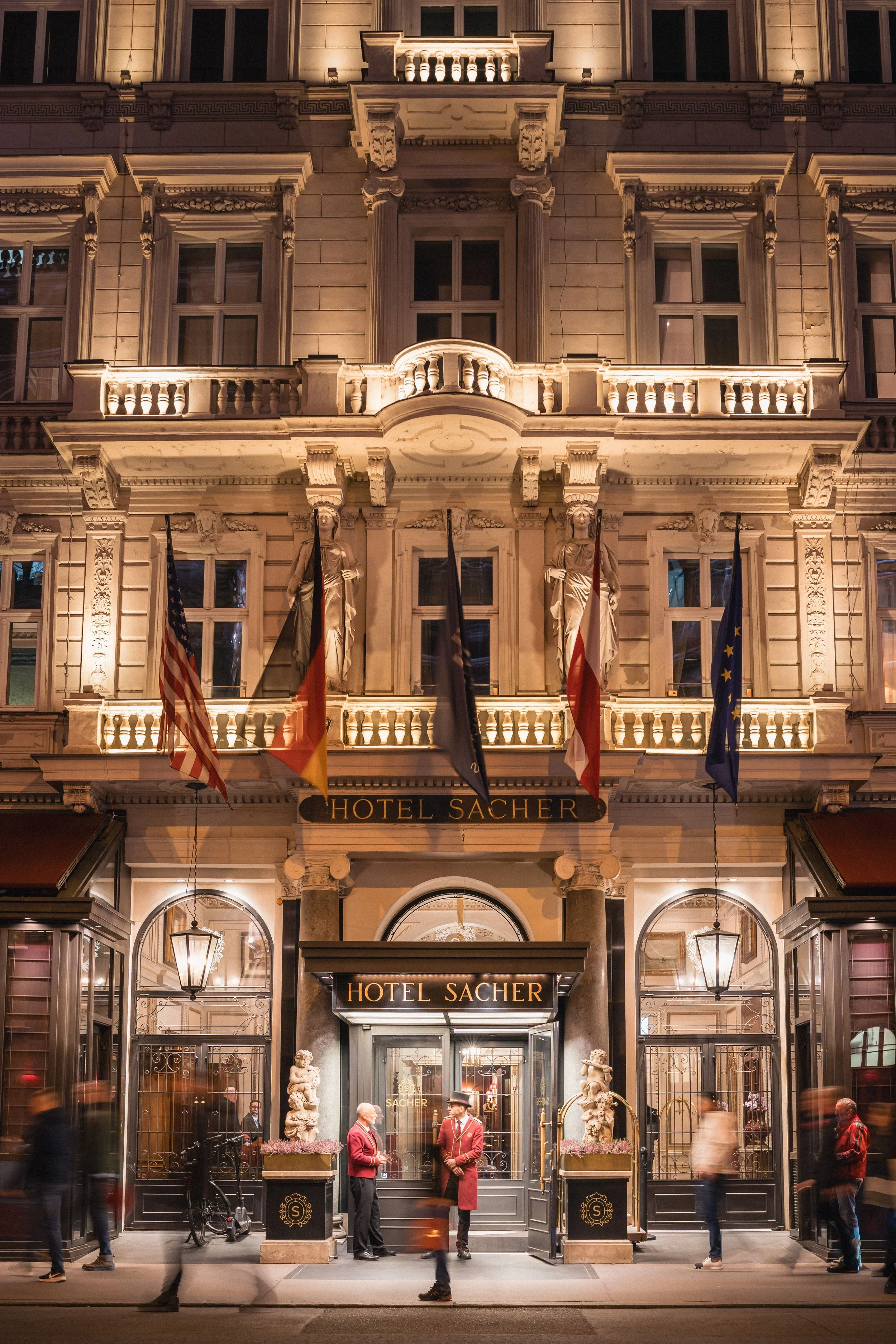
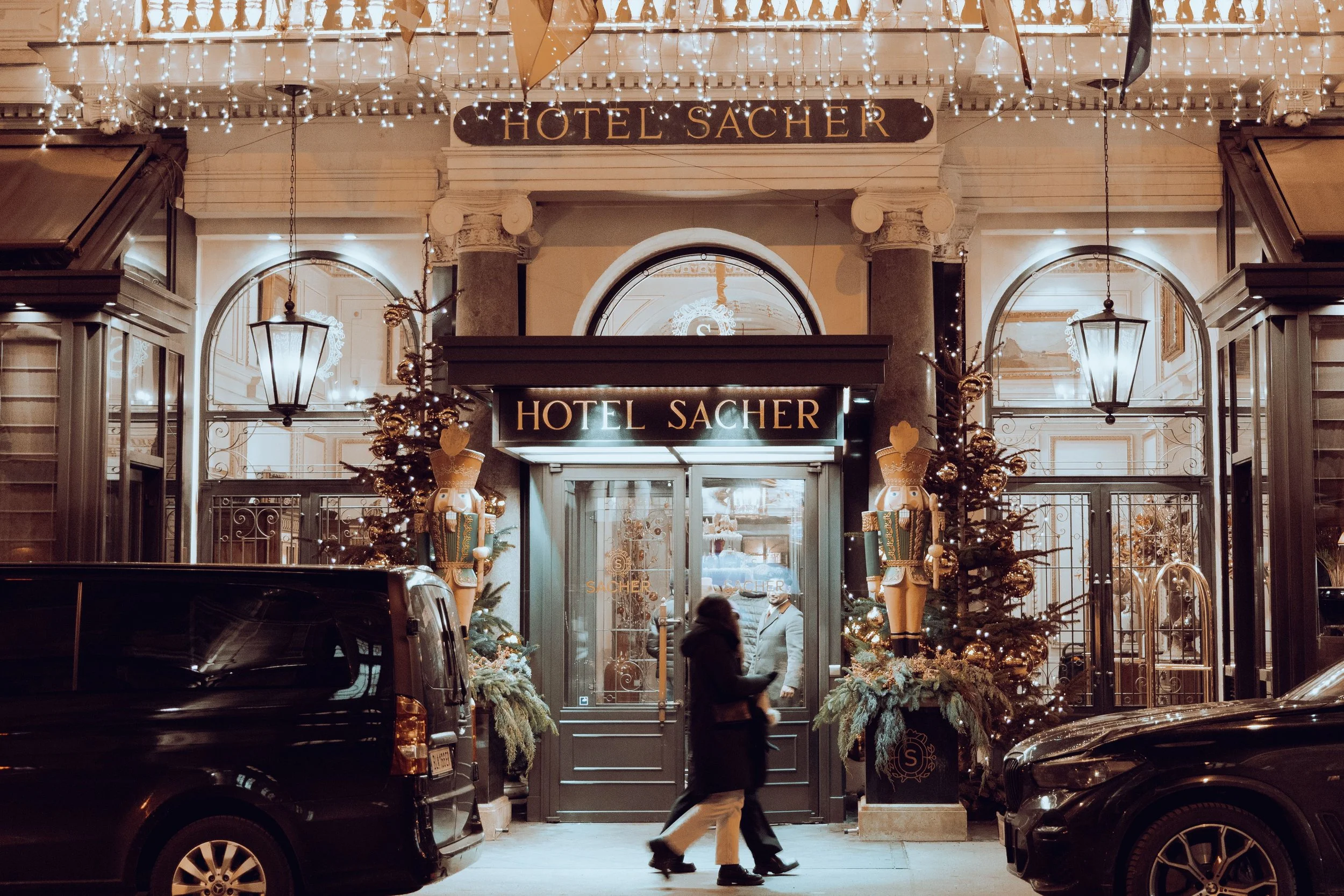
Luxury is often a misunderstood concept. A superficial view seeks luxury in soaring ceilings, gilded accents, and the bold labels of expensive fashion houses. Yet, for a refined editorial eye, true luxury is "temporal and acoustic isolation." While the freezing Viennese wind and the rattle of trams carry on outside, stepping through the iconic revolving door of Hotel Sacher causes the ambient frequency to shift instantly.
Heavy damask wallpapers, thick woven carpets laid over century-old parquet floors, and Biedermeier-era velvets absorb mechanical noise like a sponge. All that remains is the crisp, rhythmic clink of silver touching porcelain and the gentle strains of a piano floating in the background. Sacher whispers a clear message to the human mind: You are here, you are safe, and time no longer flows as it does outside.
The Neuro-Architecture: "Viennese Red" and the Ergonomics of Discretion
The mindset behind Sacher understood the psychological needs of the 19th-century Habsburg aristocracy with exquisite precision. The deep, saturated "Viennese Red" that dominates the hotel’s corridors and salons is far more than a decorative preference. From a neuro-architectural perspective, this hue possesses a spectrum that relaxes the eyes, adds dimensionality to spaces, and elevates the sense of privacy to its peak.
The Architecture of Silent Service: The hotel’s corridors are designed with subtle asymmetric angles to minimize the likelihood of guests bumping into one another—an "ergonomics of discretion" born from the 19th-century need for privacy among politicians and secret lovers.
Tactile Richness: The brass door handles, the solid oak doors polished by hand every morning, and the pure linen bedding offer a tactile richness that directly appeals to the senses, defying the sterile feel of the digital age.
"The true standard of a hotel is not measured by the brand of marble in its bathrooms, but by the absolute, seamless silence that wraps around you when you close your door at midnight. Sacher uses silence as a structural material."
Gastronomic Anatomy: The Sociopolitics of a Pastry and Terroir Balance
The Original Sacher-Torte associated with the property is much more than a famous dessert. Born in 1832 at the court of Prince Metternich, the recipe represents a gastronomic instrument of diplomacy that helped shape the history of the Austro-Hungarian Empire.
Viewed through a epicurean lens, the plate reveals a masterclass in culinary equilibrium:
Matte Finish and Acidic Balance: A genuine Sacher-Torte is never cloyingly sweet. The rich, dark chocolate structure is balanced by a layer of artisanal, tart apricot jam (Marillenmarmelade). The bright acidity cuts through the heavy cocoa notes instantly.
The Ritual of Schlagobers: The unsweetened, chilled whipped cream (Schlagobers) served alongside is not a garnish, but a gastronomic necessity. The unsweetened cream cleanses the palate from the rich cocoa butter, resetting it seamlessly for the next bite.
Haute-Cuisine & Terroir: Served in the hotel's Rote Bar, the Tafelspitz (slow-simmered prime beef) is more than a traditional dish. Sourced from small alpine farms across Lower Austria, the beef is paired with root vegetables and freshly grated horseradish, capturing the true climate and soil (terroir) of the region.
Anna Sacher's Legacy: Female Leadership and Institutional Memory
The true driving force behind Sacher’s unique identity lies in its human element rather than its architecture. Following her husband's early death in 1892, Anna Sacher took command of the hotel, cigar in hand and French bulldogs by her side, navigating and commanding the male-dominated aristocracy of her time.
Anna Sacher trained her staff to act not merely as hotel employees, but as "diplomatic guardians." Today, from the front desk team to the sommeliers, every member of the staff inherits this institutional memory. The intuitive, invisible service that anticipates a request before it is voiced—without ever feeling intrusive—remains Anna Sacher’s greatest legacy.
Conclusion: Sacher as a Cultural Anchor
Sacher does not yield to fleeting design trends or the artificial aesthetic of the digital age. Where it stood 150 years ago is precisely where it stands today.
If you are simply looking for a room to sleep in while visiting Vienna, the city offers hundreds of options. However, if you wish to experience Vienna's psychoanalytic depth, Habsburg intellectualism, and an aristocratic poise where time stands still, there is only one address. Sacher is not merely a hotel; it is a holistic sensory experience to be lived.